One thing many homeowners don’t realize is that the first sign of a skunk den is often not seeing a skunk at all.
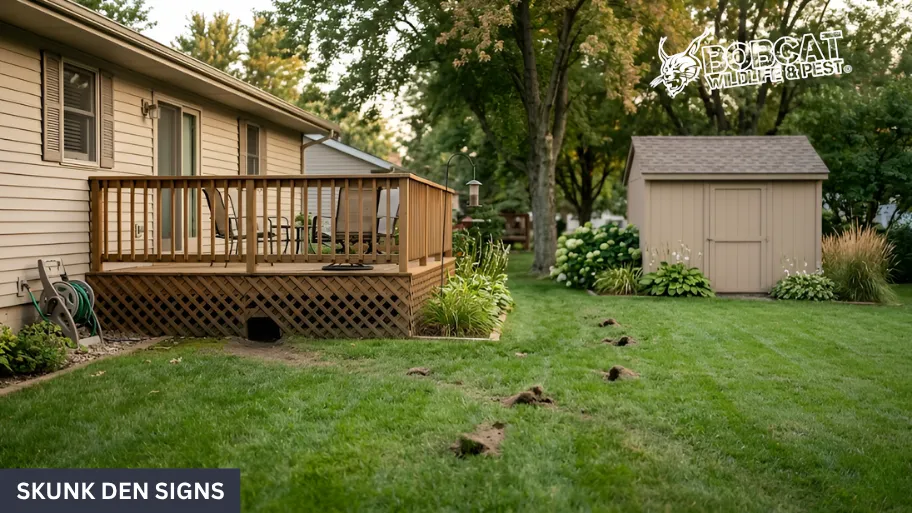
In many cases, the earliest clues are a lingering odor, small holes in the yard, or activity around decks and sheds.
As Jared Riedemann, Des Moines Branch Manager for Bobcat Wildlife & Pest Management, often advises homeowners, addressing wildlife issues early can help prevent bigger problems later.
Common signs of a skunk den include:
During the summer and early fall, many homeowners in Des Moines, IA begin noticing these warning signs as skunks search for food and shelter.
In this guide, the wildlife removal experts at Bobcat Wildlife & Pest Management explain how to identify a skunk den, where skunks commonly nest, and when professional skunk removal may be needed.
What This Guide Covers:
Why Skunks Choose Residential Properties for Their Dens
Skunks often choose residential properties because they provide shelter and easy access to food.
A deck, shed, porch, or crawl space can offer the protection a skunk needs without requiring it to dig a large den.
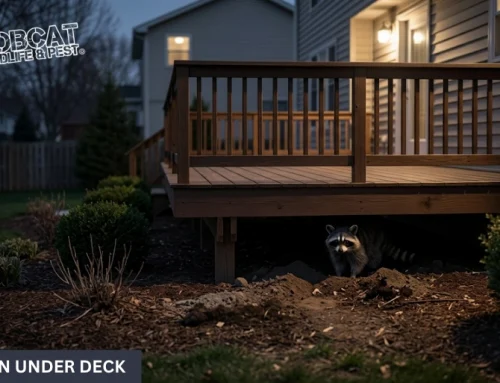
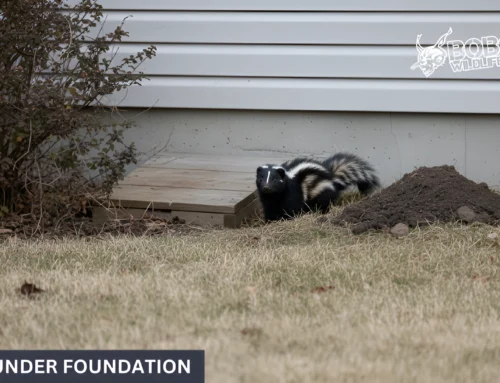
This is why a skunk den near a house is so common. A skunk living under a deck or a skunk den under a shed often means the animal has found a quiet, protected space that is easy to access.
Many homeowners are surprised to learn that skunks frequently choose the easiest location rather than the most secluded one.
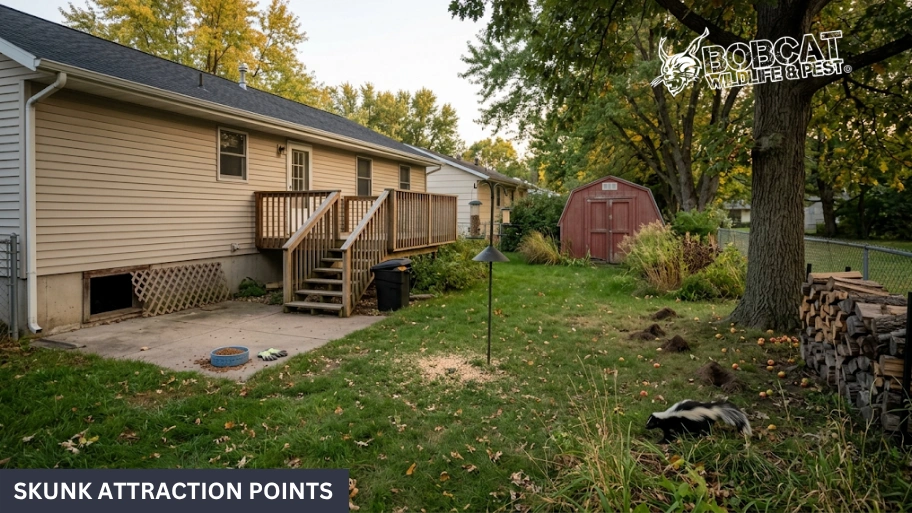
Properties with accessible shelter, grubs, fallen fruit, bird seed, pet food, or unsecured trash can be especially attractive.
Common den locations include:
Because skunks are primarily active at night, many homeowners don’t realize a den is present until they notice an odor, digging, or other signs of activity.
Common Signs of a Skunk Den Around Your Property
Skunks are secretive animals, but they rarely go completely unnoticed.
While a single sign doesn’t always confirm a skunk den, several of the following signs appearing together can indicate that a skunk has made your property part of its routine.
A Strong Skunk Smell Around Your Home
A skunk odor is one of the most recognizable signs of skunk activity, but many homeowners assume a smell automatically means a skunk has sprayed.
In reality, a persistent odor around the same area can sometimes indicate a nearby den.
Pay attention to where the smell is strongest. If the odor consistently lingers near a deck, shed, porch, or foundation, it may suggest a skunk is repeatedly entering and leaving that location.
A passing skunk usually creates a temporary odor, while a resident skunk often creates a recurring pattern.
Small Holes Appearing in Your Yard
One of the most overlooked signs of skunks is small digging activity.
Skunks digging holes in a yard are usually searching for grubs, beetles, and other insects beneath the soil.
Unlike larger wildlife, skunks typically leave shallow, cone-shaped holes rather than extensive tunneling. Homeowners sometimes mistake this damage for moles or squirrels.
A helpful clue is timing. If new holes seem to appear overnight and continue appearing in different parts of the lawn, skunks may be feeding nearby on a regular basis.
Visible Burrow Entrances Near Decks or Sheds
A skunk den under a deck or a skunk den under a shed often leaves behind subtle signs before the animal is ever seen.
Look for gaps with freshly disturbed soil, flattened vegetation, or small pathways leading to an opening.
One detail many homeowners miss is that skunks often widen existing openings rather than create new ones.
A gap that seemed harmless a few months ago can gradually become large enough for a skunk to use as a den entrance.
Tracks and Activity Around Dusk
Skunks are most active during the evening and nighttime hours.
Repeated sightings around dusk can be a strong indicator that a skunk is living nearby rather than simply passing through.
One useful clue is consistency. Skunks tend to follow familiar routes between food sources and their den.
If you repeatedly notice activity in the same area or at roughly the same time each evening, it may point to an established den somewhere on the property.
Signs of Nesting Beneath Structures
Sometimes the strongest evidence of a skunk den isn’t the skunk itself but changes around the structure where it is nesting.
You may notice loose soil near the edges of a deck, debris pushed aside beneath a shed, or areas where vegetation appears compressed from repeated use.
Homeowners with pets may also notice unusual behavior, such as a dog repeatedly investigating the same location.
Animals often detect a den long before people recognize the signs themselves.
What Does a Skunk Den Look Like?
A skunk den is usually a small opening leading beneath a structure or into a sheltered area.
Most den entrances are only a few inches tall and wide, making them much less noticeable than many homeowners expect.
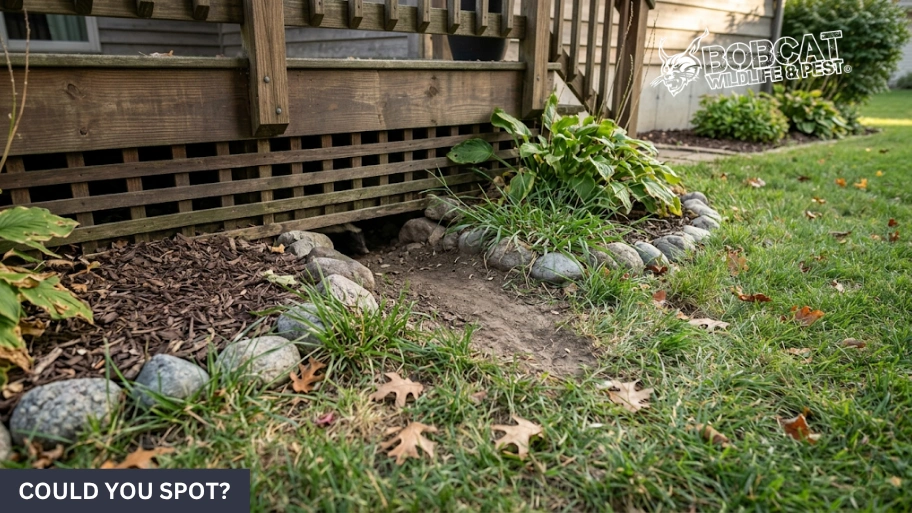
The entrance often appears as a shallow hole with smooth edges, loose soil nearby, and a clear path where the skunk regularly enters and exits.
Dens are commonly found beneath decks, sheds, porches, crawl spaces, and brush piles.
One detail that separates a skunk den from many other animal shelters is its low profile.
A skunk den is tricky to find because it looks like the area around it. Unlike bigger burrows that have dirt piles outside, a skunk den doesn’t stand out. You might miss it if you’re not looking for it.
Why You Shouldn’t Ignore a Skunk Problem
A skunk problem may seem manageable at first, but delaying action can increase the chances of more costly and frustrating issues later.
Potential risks include:
One thing many homeowners overlook is that wildlife often leaves behind opportunities for other wildlife.
A sheltered area that attracts one skunk today may attract another animal later if the access point remains open.
The sooner a skunk problem is addressed, the easier it is to protect your property, reduce future risks, and avoid the need for more extensive wildlife control measures.
Can You Remove a Skunk Under a Deck or Shed Yourself?
Yes, it is sometimes possible to remove a skunk under a deck or remove a skunk under a shed yourself.
However, successful removal involves more than simply getting the animal to leave.
Before attempting a DIY solution, consider:
One thing many homeowners don’t realize is that the hardest part is often preventing the skunk from returning.
If access points remain open, another skunk or other wildlife may use the same area in the future.
For many homeowners, professional skunk removal provides a safer way to remove the animal, identify access points, and help prevent recurring wildlife problems.
How Professional Skunk Removal Works
A professional skunk removal service focuses on more than removing the animal itself.
The goal is to address the conditions that allowed the skunk to settle on the property in the first place.
While the exact process varies from one situation to another, humane skunk removal typically involves:
One thing many homeowners don’t realize is that wildlife removal is often as much about prevention as it is about removal.
If a den site remains accessible, the same location may continue attracting skunks or other animals in the future.
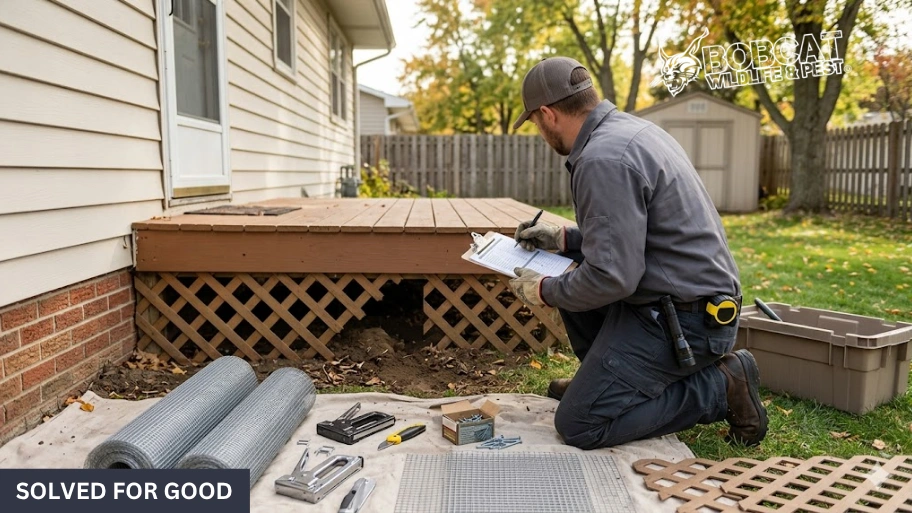
A professional wildlife removal service helps ensure the issue is addressed completely rather than temporarily.
This can reduce the likelihood of recurring wildlife problems and help protect your property over the long term.
At Bobcat Wildlife & Pest Management, our team uses proven wildlife management techniques to help homeowners safely and effectively resolve skunk issues throughout the Des Moines area.
How to Prevent Future Skunk Dens on Your Property
The best way to prevent future skunk dens is to eliminate access to shelter and reduce attractants around your property.
To help discourage skunks from settling near your home:
One thing many homeowners don’t realize is that preventing future dens is often easier than dealing with an active one.
Once a skunk discovers a safe shelter location, it may return repeatedly unless the access point is properly secured.
Combining exclusion, sanitation, and routine property maintenance can significantly reduce the likelihood of future skunk activity.
When to Contact a Wildlife Removal Professional
Many skunk problems become more complicated because homeowners make reasonable assumptions that turn out to be wrong.
It may be time to contact a wildlife removal professional if:
One thing many homeowners don’t realize is that the hardest part is often diagnosing the situation correctly.
Knowing a skunk is present is one thing. Knowing whether the den is active, abandoned, temporary, or being used by multiple animals is another.
A professional inspection can help answer those questions before action is taken. This reduces the risk of unnecessary repairs, ineffective exclusion efforts, and recurring wildlife problems.
If you think a skunk is living under your house, call Bobcat Wildlife & Pest Management. They can help you figure out what to do.
Skunk Den FAQs for Iowa Homeowners
Will a skunk leave on its own?
Yes, a skunk may leave on its own, but there is no reliable way to predict when that will happen. Some skunks use a den temporarily, while others may return repeatedly if the location remains safe and accessible.
One thing many Iowa homeowners don't realize is that a skunk leaving doesn't necessarily mean the problem is solved.
If the shelter remains available, another skunk or other wildlife may move in later.
That's why Bobcat Wildlife & Pest Management often recommends addressing both the animal and the access point.
How long do skunks stay in the same den?
Skunks can stay in the same den for several days, weeks, or even longer depending on weather conditions, food availability, and breeding activity.
A common misconception is that skunks remain in one location year-round.
In reality, skunks may use multiple den sites throughout the year and move between them as conditions change.
This is one reason wildlife activity in Des Moines, IA sometimes appears to disappear and then return unexpectedly.
Do skunks return to the same den every year?
Yes, skunks may return to the same den if it continues to provide shelter and easy access.
Even if the original skunk does not return, the location itself may remain attractive to future wildlife.
Many homeowners focus on removing the animal but overlook the den site. The long-term goal is to make the area less accessible so it no longer serves as a suitable shelter.
Bobcat Wildlife & Pest Management often finds that recurring wildlife problems are tied to the same unresolved access points.
Can skunks live under a deck without being noticed?
Yes, skunks can live under a deck for weeks or even months without being noticed, especially if they are entering and exiting during the evening hours.
One reason this happens is that homeowners often expect to see the animal itself. In reality, wildlife is usually detected through patterns and indirect evidence rather than direct sightings.
This is why professional wildlife inspections in Des Moines, IA often uncover activity that homeowners suspected but could not confirm.
What time of year are skunks most active in Iowa?
Skunks can be active throughout the year, but many Iowa homeowners notice increased activity during spring, summer, and early fall when skunks spend more time foraging and raising young.
A lesser-known fact is that skunks do not truly hibernate. During colder periods, they may become less active and remain in dens for longer stretches, but they can still emerge when conditions allow.
This means wildlife issues can develop at almost any time of year, even when activity appears to slow down.
Can a skunk den damage my home's foundation or structure?
A skunk den is unlikely to cause major structural damage on its own, but it can contribute to problems if left unaddressed.
Repeated digging around foundations, decks, and sheds may gradually enlarge existing gaps and create easier access for other wildlife.
One thing many homeowners in Des Moines, IA don't consider is that the opening itself often becomes the bigger issue.
Once wildlife discovers a reliable shelter location, additional animals may attempt to use the same area in the future.
What should I do if my dog finds a skunk den?
If your dog discovers a suspected skunk den, keep pets away from the area and avoid investigating the den yourself.
Disturbing a den can increase the chances of a defensive spray or other wildlife encounters.
Many pet owners focus on the skunk, but the more important question is whether the den is actively being used.
Bobcat Wildlife & Pest Management recommends monitoring the area from a distance and seeking professional guidance if activity continues.
Can more than one skunk live in the same den?
Yes, multiple skunks may use the same den under certain conditions, particularly during colder months or when a mother is raising young.
One misconception is that every den contains only one animal. While many skunk dens are occupied by a single skunk, the number can vary depending on the season and circumstances.
This is one reason wildlife professionals inspect den sites carefully before recommending removal or exclusion measures.
Should I block the entrance to a suspected skunk den?
No, you should not block the entrance unless you are certain the den is inactive. Sealing an active den can create additional wildlife problems and make the situation more difficult to resolve.
One of the most common mistakes wildlife professionals encounter is homeowners assuming a den has been abandoned simply because they haven't seen activity recently.
In reality, skunks may remain hidden for long periods and continue using the den without being noticed.
How can I tell if a skunk den is active or abandoned?
The most reliable way to determine whether a den is active is to look for signs of recent use over several days.
Fresh tracks, newly disturbed soil, and recurring activity near the entrance can all indicate an active den.
A detail many homeowners overlook is that wildlife activity often follows a pattern. If signs continue appearing in the same location, the den is more likely to be active.
If you're unsure, Bobcat Wildlife & Pest Management can help evaluate suspected den sites throughout Des Moines, IA and recommend appropriate next steps.

About the Author
Jared Riedemann is the Des Moines Branch Manager for Bobcat Wildlife & Pest Management. He works closely with homeowners and businesses throughout the Des Moines Metro area to solve pest and wildlife problems and help protect their properties.
Jared believes early action is the key to preventing larger pest issues. Through his hands-on experience and commitment to customer service, he helps property owners find effective solutions for a wide range of pest and wildlife concerns.